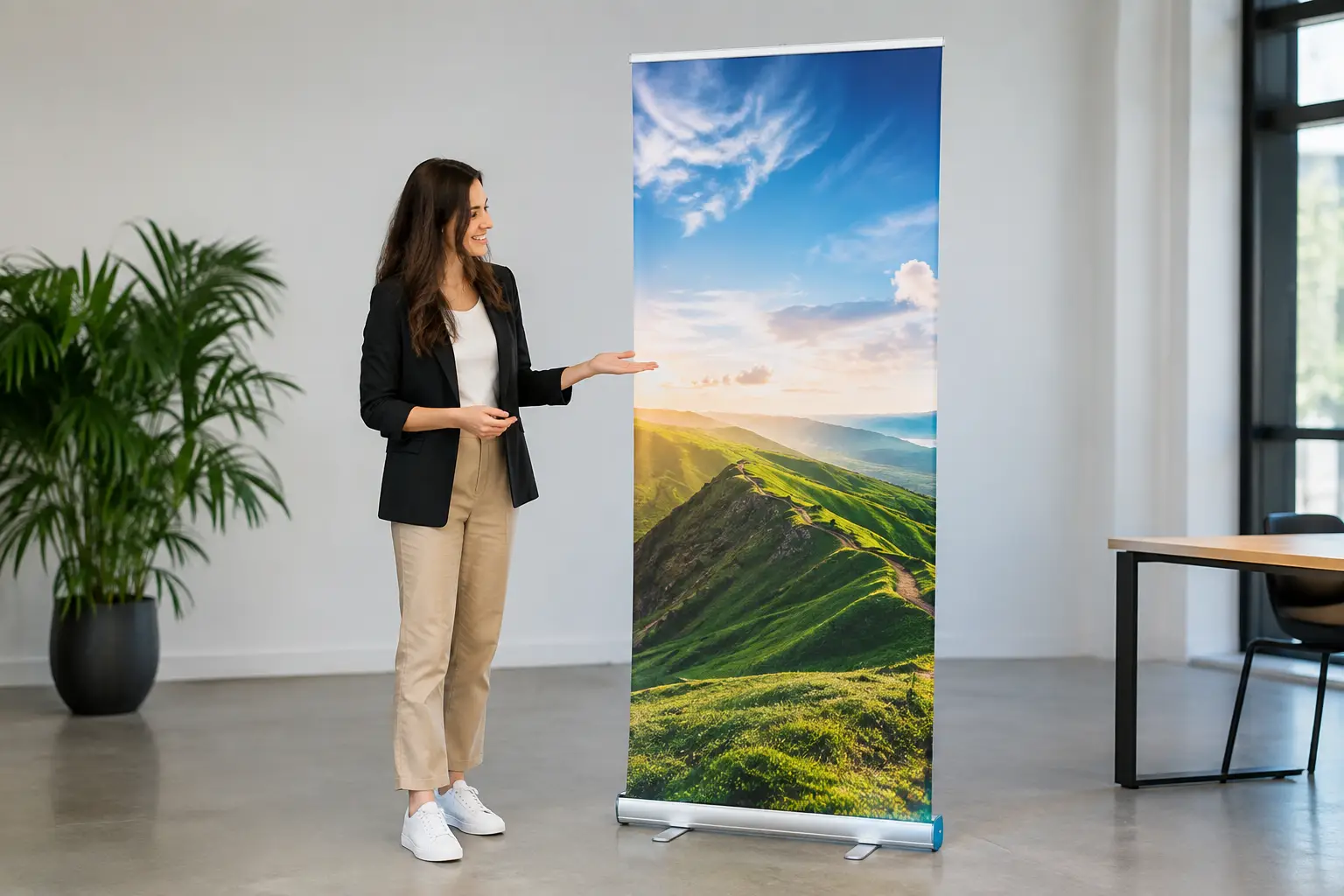
A busy exhibition hall, a shop launch or a last-minute networking event gives you only a few seconds to make your message visible. So, what is a pop up banner? It is a portable printed display that sets up quickly, giving your business a large, professional advertising space without the cost or hassle of a permanent sign.
For many UK businesses, the term usually refers to a roller banner: a tall graphic panel that pulls up from a compact base and is held in place by a support pole. It is one of the simplest ways to put your brand, offer or event message in front of people when time, space and budget are tight.
What Is a Pop Up Banner Used For?
A pop up banner is a free-standing promotional display designed to travel easily and work almost anywhere. It is commonly used at trade shows, conferences, reception areas, retail premises, schools, charity events, open days and product launches. Once the event is over, it rolls back into its base or packs into a carry case for storage and transport.
The real value is visibility. A well-designed banner can show who you are, what you offer and how people can act next, even when nobody is standing beside it. Put one by a stand, entrance, till point or presentation area and it continues working throughout the day.
They are particularly useful when a business needs a professional presence without arranging a full exhibition stand. A roller banner can be set up in minutes, carried in a car and reused across several campaigns. That makes it a practical choice for small businesses, sales teams and event organisers managing costs carefully.
Pop Up Banner, Roller Banner or Exhibition Display?
These names are often used interchangeably, but there can be a difference.
In everyday print buying, a pop up banner normally means a pull-up roller banner. The printed material is stored inside an aluminium cassette base. You pull the graphic upwards, attach it to a pole and the tensioned mechanism keeps it flat and upright.
A traditional pop-up exhibition display is often larger. It may use a collapsible frame with magnetic graphic panels or a fabric graphic that stretches over the frame. These displays can create a wider backdrop for a stand, photo opportunity or press area.
Both options are portable, but they suit different jobs. A roller banner is better for a focused message in a narrow space. A larger pop-up display makes more sense when you need a branded background, have a bigger stand footprint and want greater visual impact. If you simply need a fast, affordable display for an event, a roller banner is usually the sensible starting point.
How Does a Roller Pop Up Banner Work?
The banner graphic is printed on a durable display material and fitted into a weighted base. Inside the base is a spring-loaded roller mechanism. This allows the graphic to retract safely when it is not in use.
To assemble it, place the base on a level surface, pull the banner up carefully, connect the support pole and hook the top rail onto it. Most standard units take less than a minute to install. A carry case protects the banner during transport and makes it easier to move between venues.
The mechanism is simple, but it still needs sensible handling. Do not let the graphic snap back uncontrolled, as this can damage the print or roller. Avoid placing a lightweight indoor banner in strong wind, near an open doorway or outdoors unless it has been made for external use. For outdoor promotions, a PVC banner, flag or purpose-built outdoor display may be a more reliable choice.
Why Businesses Choose Pop Up Banners
A pop up banner earns its place because it solves several practical problems at once. It is quick to deploy, easy to transport and gives a campaign a more established look than a loose poster or stack of leaflets alone.
It is also reusable. Rather than printing a new sign for every appearance, you can use the same banner at meetings, exhibitions, networking sessions and customer visits. For a core message such as your services, company credentials or a year-round product range, this can offer strong value over time.
The trade-off is that a banner is not a full exhibition stand. It has limited room for detail and needs a clear message to work from a distance. Trying to include every service, every price and every social media handle can make it difficult to read. Think of it as a visual signpost, not a brochure.
Choosing the Right Size and Style
The right banner depends on where it will stand and how far away it needs to be seen. A standard roller banner is often around 800mm to 850mm wide and approximately 2,000mm tall. This is a popular size because it is prominent without taking up too much floor space.
Wider formats can give your design more breathing room and work well behind a table, in a showroom or beside a larger exhibition stand. Narrower banners are useful for tight reception areas, corridors and compact retail displays. Before ordering, measure the available floor space and consider ceiling height, especially in smaller venues.
Base style matters too. Budget roller banners are ideal for occasional indoor use and short campaigns. Premium cassette models tend to have a sturdier base, smoother operation and a more polished finish, making them a better choice for businesses attending frequent events. The best option is not always the cheapest unit – it is the one that matches how often you will use it and where it needs to travel.
What Should Go on a Pop Up Banner?
People should understand the main point of your banner in a glance. Start with one clear headline, such as a service, promotion or event name. Support it with a strong image or simple visual, then add only the essential details.
Your logo should be visible near the top, where it is less likely to be blocked by furniture or people. Put the key message in the central area, using large type and good contrast. Contact details, a website address or a QR code can sit lower down, but do not make them the only thing a viewer sees.
A useful order is: brand, main benefit, supporting information and call to action. For example, a local trades business might lead with “Boiler Repairs Across Glasgow”, follow with “Fast appointments and clear pricing”, then include a phone number and QR code. An event organiser may lead with the event name, date, venue and a simple booking prompt.
Avoid pale text on a pale background, busy stock imagery and long paragraphs. If someone cannot read the central message from several metres away, the design needs simplifying. A banner is viewed standing up and often while people are moving, so clarity beats cleverness.
Preparing Artwork for Print
Good print starts with usable artwork. Images should be high resolution, logos should be supplied in a suitable quality and text should be checked carefully before production. A spelling error on a reusable display is more costly than one on a short flyer run.
Keep important wording and logos away from the very edges. On roller banners, the lower section may disappear into the base, while the top and sides need a small safe area to prevent essential details sitting too close to the trim. Your printer can provide an artwork template showing the exact visible area and bleed requirements.
If you are working to a deadline, do not leave approval until the last hour. Confirm the finished size, check the design at full scale where possible and make sure the contact details are correct. A fast turnaround is most useful when the artwork is ready to print.
When a Pop Up Banner Is the Right Investment
Choose a pop up banner when you need a portable, repeat-use display for an indoor environment. It is ideal for promoting a service at a trade show, welcoming visitors to an open day, supporting a sales presentation or adding branding to a temporary retail space.
It may not be the best choice for every job. If you need to cover a large wall, a printed backdrop could be more effective. If your message must be fixed outside for weeks, a PVC banner or rigid sign is likely to suit the conditions better. If the campaign changes every few days, posters may offer greater flexibility at a lower replacement cost.
For businesses that need banners quickly, G1 Printing can produce practical event-ready displays with fast UK-wide delivery options. The key is to order a format that fits the venue and keep the message focused enough to be noticed.
A good pop up banner does not need to say everything about your business. It needs to make the right people stop, understand the offer and take the next step.