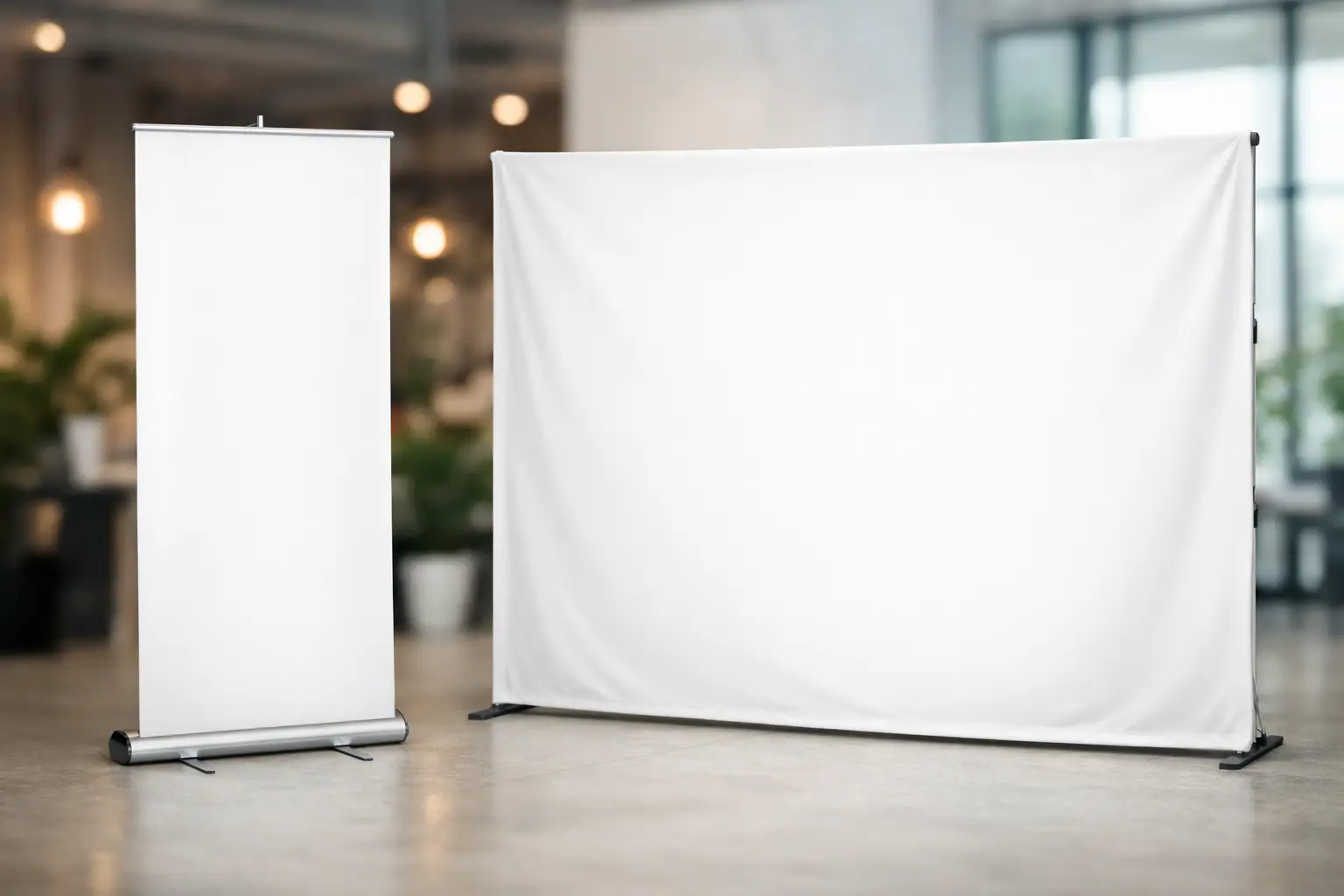
A roller banner versus fabric display decision usually comes down to one practical question: do you need a smart display in your hands quickly, or are you building a larger branded presence that will be used again and again? Both can look professional at exhibitions, conferences, retail promotions and receptions. The right choice depends on your space, budget, artwork and how often the display will travel.
For many businesses, a roller banner is the fastest route from approved artwork to event-ready marketing. Fabric displays bring a different set of advantages, particularly where a bigger visual impact or a polished backdrop is needed. Here is how to choose without paying for more display than the job requires.
Roller banner versus fabric display: the key difference
A roller banner is a printed graphic that rolls neatly into a cassette base. When you arrive at the venue, pull the banner up, secure it on the support pole and it is ready to use. It is compact, portable and designed for quick set-up by one person.
A fabric display uses a printed textile graphic, usually stretched over a lightweight frame or supplied as part of a tension-fabric system. The result is often wider, taller and more visually continuous than a single roller banner. Depending on the system, the graphic may be fitted around the frame like a sleeve or attached with silicone edging.
Neither is automatically better. Roller banners are built for speed and convenience. Fabric displays are designed for stronger visual coverage and a more substantial exhibition-style finish. The better value option is the one that matches the event rather than the one with the highest initial price.
When a roller banner is the sensible choice
Roller banners are a reliable choice for businesses working to a close deadline. They are especially useful for a sales meeting, recruitment fair, training day, shop promotion, local event or trade stand where you need clear branding without complicated installation.
Set-up is one of their biggest strengths. A member of staff can carry the banner in a supplied case, position it at the venue and have it standing in minutes. That matters when access slots are short, the event team is stretched, or you are setting up before customers arrive.
They also make financial sense when you need several messages in different places. A café might use one banner to promote catering, another for loyalty offers and a third for event bookings. A service business can take a single banner to networking events, then place it in reception between appointments. Instead of investing in one large structure, you can put focused messages where they will be seen.
The print area is tall and narrow, so the design needs to be simple. One headline, a strong image or product benefit, key contact details and a clear call to action will usually work better than a crowded brochure layout. A roller banner is not the place to explain every service you offer from top to bottom.
Best uses for roller banners
Roller banners suit entrance areas, retail floors, smaller exhibition stands, presentations, school and community events, hospitality venues and pop-up promotions. They are also a practical back-up display. If a last-minute campaign needs physical branding, a roller banner can be ordered, transported and deployed with very little fuss.
For urgent UK event work, this is where a fast-turnaround print supplier such as G1 Printing can make the difference between arriving with a proper display and arriving with nothing but a laptop screen.
Where fabric displays earn their cost
Fabric displays come into their own when the display itself is part of the experience. A large tension-fabric wall creates a clean branded background for conversations, product demonstrations, photographs and social content. It gives a stand more presence than several small signs placed around the edges.
The material finish can also look softer and more premium under exhibition lighting. Unlike a standard pull-up banner, a fabric graphic has no cassette running across the bottom of the visible design. It can create an uninterrupted image across a wider area, which is useful for photography, bold brand artwork and repeating logos.
A fabric backdrop is often the stronger choice for a step-and-repeat photo wall, a launch event, a larger shell-scheme stand or a venue where branded photographs will be used after the event. If attendees, speakers or customers are likely to stand in front of it, plan the artwork around where faces will appear. Put logos and key graphics around the outer sections rather than placing important details in the middle.
Fabric systems can be reused effectively, particularly if your core branding stays consistent. Some frames also allow replacement graphics, so you can keep the hardware and update the fabric for a new campaign. This can improve long-term value, but only if you will genuinely use the system enough to justify the higher starting cost.
Allow extra time for set-up and packing
Fabric displays are still portable, but they are not always as instant as a roller banner. The frame needs assembling and the fabric needs fitting correctly to avoid a skewed or loose finish. On a compact system, this may take only a few minutes. On a larger wall, allow more time and, where possible, have two people available.
The fabric should also be packed carefully after use. Keep it dry, avoid folding it around sharp hardware and follow the supplied packing method. Creases may relax once the graphic is tensioned, but careful handling keeps the display looking its best over repeated events.
Budget, transport and venue space
The most useful comparison is not just purchase price. Consider the total cost of using the display: transport, storage, staff time, replacement graphics and whether it can serve more than one event.
A roller banner is usually the lower-cost entry point and takes up very little storage space. It fits easily into a car boot and is straightforward to send with a staff member travelling by train or taxi. If you need multiple displays for branches, venues or sales representatives, that portability can save time as well as money.
A fabric display requires more initial investment, particularly at wider sizes. It may come in a larger carry case and need more room in storage. However, it can reduce the need for separate background signs, making it worthwhile for businesses that exhibit regularly or need a professional setting for photographs.
Venue size should shape the decision. In a narrow reception area, a wide fabric wall can overwhelm the space and block movement. A roller banner will often do the job more neatly. On a 3m exhibition stand, one roller banner can look lost unless it is supported by a counter, posters or additional signage. A fabric backdrop can fill that space more confidently.
Print quality and artwork considerations
Both formats can produce sharp, high-impact branding when the artwork is supplied correctly. Start with the correct template for the product size. This avoids vital text sitting too close to edges, disappearing behind the roller banner cassette or being placed where the fabric frame affects visibility.
Use high-resolution images and avoid screenshots, small web images or logos copied from low-quality files. For text, prioritise legibility from a distance. Exhibition visitors should understand who you are and what you offer in a few seconds, even when walking past.
Colour matters too. A bright display can attract attention, but it must still match your wider brand identity across flyers, business cards, posters and digital marketing. Use CMYK-ready artwork where possible and check that black text is clean and readable. If brand colour accuracy is critical, allow time to discuss proofing and production requirements before the event deadline becomes tight.
Choose based on the job, not the trend
Choose a roller banner if you need a compact, affordable display that can be set up quickly almost anywhere. It is the practical choice for one-person set-up, short campaigns, limited floor space and deadline-driven events.
Choose a fabric display if you need a larger branded surface, a backdrop for photography or a stand that feels more permanent. It is well suited to regular exhibitors, launches and spaces where the display needs to carry the visual weight of the whole area.
There is also a strong case for using both. A fabric wall can define the back of a stand, while a roller banner at the aisle edge promotes a specific offer or directs visitors towards a demonstration. That combination gives you broad brand presence and a focused sales message without cluttering the space.
Before ordering, measure the venue area, confirm set-up access, check the event deadline and decide what a visitor should notice first. A display that is easy to transport, quick to install and clear from a distance will work harder for your business long after the doors open.