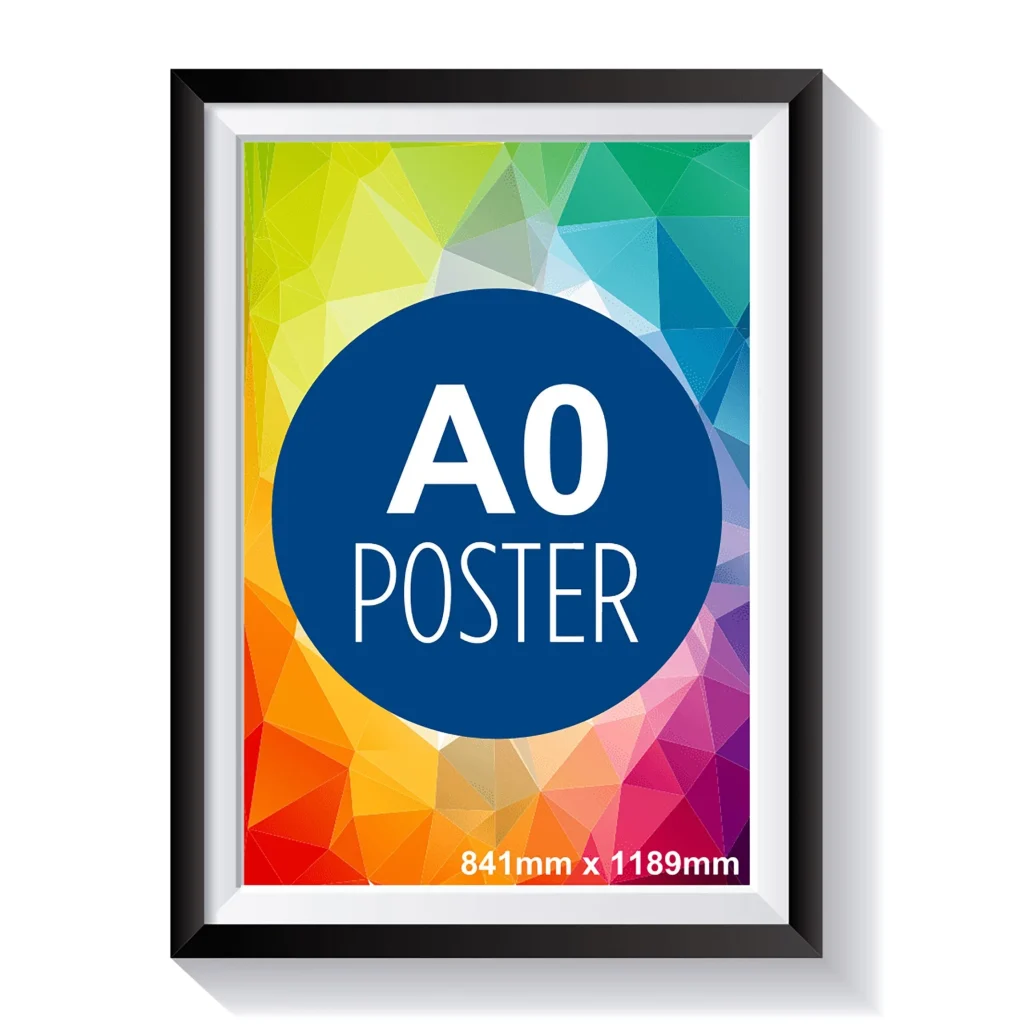
Need an A0 poster printed fast? We print and finish A0 posters right here in Glasgow or Scotland, with same-day delivery for local orders and next-day delivery across the rest of the UK. Whether it’s a conference display, shop window, event banner or art print, your poster is ready in hours, not days.
A0 Poster Printing size: 841 x 1189mm — the standard for exhibition stands, retail displays and large-format artwork.
A0 Poster Printing Prices
Free File Check, Free Packaging, Free Delivery!
| Finish | Price from |
|---|---|
| 170gsm satin paper | £39 |
| 100gsm Polyester | £56 |
| Matt 190gsm | £49 |
| PVC (outdoor use) | £54 |
| Self-adhesive vinyl | £67 |
Prices include VAT. No minimum order — need just one poster? No problem.
We print A0 posters every day & deliver FAST!

Same-Day Delivery in Glasgow
Order before 2pm and receive your A0 poster the same day from our Glasgow print unit. Can’t collect in person? We deliver next-day across mainland Scotland and the rest of the UK.
- Order online, upload your artwork, choose your finish
- We print in-house — no third-party delays
- Collect locally or have it couriered to your door
Finishes & Materials
- Matte paper (190gsm) — everyday posters, indoor use, no glare.
- Satin/gloss (170gsm) — vivid colour, ideal for photography and art prints.
- Laminated — scuff and moisture-resistant, good for repeated handling.
- PVC — weatherproof, built for shop windows and outdoor display.
- Self-adhesive vinyl — sticks direct to walls, windows or boards.
What A0 Posters Are Used For
- Exhibition and trade show displays
- Shop window advertising
- Event and gig posters
- Office and boardroom prints
- Art and photography prints
- Estate agent window boards
How to Order
- Upload your artwork (PDF or JPEG, 300 DPI, CMYK)
- Choose your finish and quantity
- Select collection (Glasgow) or delivery
- Pay securely online
- Collect same-day or receive next-day delivery
Need design help? Ask about our design service — from £25.
FAQs
How quickly can I get an A0 poster printed in Glasgow?
Order before 3pm for same-day delivery. Delivery orders placed by 3pm arrive next working day.
What file format do you need?
PDF or JPEG, supplied at 300 DPI in CMYK for best results. We can advise if you’re not sure.
Can I order just one poster?
Yes — no minimum order.
Do you deliver outside Glasgow?
Yes, next-day delivery is available across mainland Scotland and the UK.
What’s the difference between matte and gloss?
Matte reduces glare and suits text-heavy posters; gloss gives richer colour and suits photography or artwork.
Why Glasgow People & Visitors to the SEC Trust Us With Their A0 Prints
We’ve been printing in Glasgow since 2005, which means we’ve seen print technology move from spot-colour lithographic through to the wide-format digital presses we run today. That history matters when you’re printing something as unforgiving as A0: get the colour profile wrong, or use the wrong stock for the finish, and a large-format print shows every flaw at a distance a business card never would.
All of our A0 work is produced in-house, on our own machines, by the same team who’ll answer the phone if there’s a query about your file. We don’t outsource to a third-party trade printer and relabel the box — when we quote same-day delivery, it’s because the poster is printed and finished on our premises, not couriered in from elsewhere.
Every job goes through a manual pre-flight check before it hits the press: bleed, resolution, colour mode and font embedding are all verified by hand, not just an automated upload gate. If your file’s supplied at the wrong DPI or in RGB instead of CMYK, we’ll flag it and advise on a fix rather than printing it as-is and letting the result speak for itself.
We print for a wide mix of local clients — exhibition stands, estate agents’ window boards, gig posters, retail displays — so we’ve a good feel for which finish suits which use: PVC for anything going outside, laminate for posters that’ll be handled repeatedly, matte for text-heavy conference boards where glare under strip lighting is a real problem.
If you’re not sure which spec is right for your job, call us on 0141 374 2615 or send your file to us for a free check before you commit to an order.
A0 Posters Printing Delivered
A0 Poster specs & prices
Special Offer A0 Poster Delivered – £39, plastic wrapped. 3 working days. Buy here and send your file here
Academic conferences are the lifeblood of research communities across the United Kingdom. From the bustling halls of Imperial College London to the historic venues of Edinburgh’s universities, researchers gather to share their latest findings through presentations and poster sessions. While PowerPoint slides might dominate the main auditoriums, it’s often the poster sessions where the most engaging conversations happen. That’s where academic poster printing becomes absolutely crucial to your success.
Whether you’re a PhD student at Manchester University preparing for your first conference or a seasoned researcher from Cambridge heading to an international symposium, getting your poster printed professionally can make the difference between blending into the background and attracting the attention your research deserves.
Understanding Academic Poster Printing
Academic poster printing isn’t just about enlarging your research summary onto a big sheet of paper. It’s a specialized printing process that requires careful consideration of materials, colours, text readability, and durability. Unlike regular printing you might do at your local print shop in Birmingham or Leeds, academic posters need to withstand transportation, handling, and display for several hours while maintaining their professional appearance.
The printing process itself involves large-format printers that can handle paper sizes well beyond what you’d find in any standard office. These industrial machines, commonly found in specialized printing facilities across cities like Bristol, Newcastle, and Glasgow, use advanced inkjet or latex printing technology to ensure sharp text and vibrant images that remain clear even when viewed from several feet away.
Most academic posters are printed on paper sizes ranging from A1 to A0, though some conferences may request even larger formats. To put this in perspective, an A0 poster measures 841mm by 1189mm – that’s nearly a meter wide and over a meter tall. When you’re dealing with prints this large, every detail matters, from the resolution of your images to the font size of your smallest text.
Choosing the Right Printing Materials
The material you choose for your poster can significantly impact both its appearance and durability. Most print shops in cities like Oxford, Sheffield, or Liverpool will offer several options, each with distinct advantages.
Standard paper is the most economical choice and works well for indoor conferences held in controlled environments like those at the University of Warwick or King’s College London. However, paper can be fragile during transport and may not lay flat when hung, especially in venues with air conditioning or heating systems that create air currents.
Photo paper provides superior image quality with a glossy or satin finish that makes colours pop and images appear more vibrant. This option works particularly well for research in fields like biology, medicine, or any discipline where high-quality images are crucial to understanding your findings. Many researchers presenting at conferences in Brighton or Bath choose photo paper when their posters include microscopy images, charts, or photographs.
Fabric printing has become increasingly popular among UK academics in recent years. Companies in Manchester, Birmingham, and London now offer fabric poster printing that creates lightweight, wrinkle-resistant posters that can be folded for transport without damage. These fabric posters often include a slight texture that reduces glare under conference lighting, making them easier to read in venues like the International Convention Centre in Birmingham or the SEC Centre in Glasgow.
Vinyl printing offers the ultimate in durability. While more expensive, vinyl posters can withstand outdoor use, moisture, and repeated handling. Researchers attending field-based conferences or outdoor symposiums often choose vinyl printing from specialized shops in cities like Nottingham or Portsmouth.
Design Considerations for Printing
Creating an effective academic poster requires understanding how your design will translate to print. What looks perfect on your laptop screen in your office at the University of Edinburgh might appear quite different when printed at full size and viewed under conference lighting.
Font selection becomes critical when you’re designing for large-format printing. Text that appears readable on your computer screen might become thin and difficult to read when printed, especially if conference attendees will be viewing your poster from distances of three to six feet. Print shops in cities like Plymouth, Cardiff, or Aberdeen often recommend serif fonts for body text and clean sans-serif fonts for headings, as these translate better to large-format printing.
Colour choices also require special consideration. The RGB colour space used by computer monitors differs from the CMYK colour space used by most professional printers. That vibrant blue that looks perfect on screen might print as a muddy purple if you don’t account for this difference. Experienced printing shops in London, Manchester, or Leeds will often provide colour proofing services, allowing you to see exactly how your colours will appear in print before committing to the full poster.
Image resolution becomes absolutely critical at large poster sizes. Images that look sharp on your screen might appear pixelated when enlarged to poster size. Most printing professionals recommend using images with a resolution of at least 150-200 DPI at the final print size. This means a image that will be printed at 6 inches wide should have a resolution of at least 900-1200 pixels wide.
The Printing Process Across the UK
The landscape of academic poster printing has evolved significantly across the UK in recent years. Major cities like London, Birmingham, Manchester, and Edinburgh boast numerous specialized academic printing services, while smaller university towns like Durham, St. Andrews, and Exeter have developed their own ecosystem of student-friendly print shops.
In London, the concentration of universities and research institutions has created a competitive market for academic printing services. Areas around Imperial College, UCL, and King’s College are dotted with printing shops that understand the specific needs of academic conferences. Many of these businesses offer same-day service for standard poster sizes and materials, recognizing that researchers often face tight deadlines before conferences.
Manchester’s strong university presence has similarly fostered a robust printing industry. Print shops near the University of Manchester and Manchester Metropolitan University often specialize in academic work, offering student discounts and bulk pricing for research groups. The city’s central location makes it a popular choice for researchers from across the North of England.
Edinburgh’s printing scene benefits from both the University of Edinburgh and Heriot-Watt University. The city’s compact size means most printing services are easily accessible, and many shops have developed expertise in serving the academic community’s specific needs, from conference posters to thesis printing.
Glasgow offers competitive pricing and quick turnaround times, making it an attractive option for researchers throughout Scotland. The city’s printing industry has adapted well to serving both the University of Glasgow and the University of Strathclyde, with many shops offering specialized academic services.
Regional centres like Bristol, Liverpool, Leeds, and Newcastle have each developed their own specialties. Bristol’s printing industry often excels in environmental and sustainability options, reflecting the city’s green initiatives. Liverpool’s shops frequently offer competitive pricing for bulk orders, while Leeds has become known for high-quality photo printing services. Newcastle’s printing scene has developed strong expertise in fabric printing, partly due to the city’s textile heritage.
Cost Considerations and Budgeting
Academic poster printing costs vary significantly depending on size, material, quantity, and location across the UK. Understanding these cost factors can help you make informed decisions and budget appropriately for your conference presentations.
Size is typically the primary cost driver. An A1 poster might cost £15-25 at most UK print shops, while an A0 poster could range from £25-45. Specialty materials add to these base costs – fabric printing might add £10-20 to the basic price, while vinyl could increase costs by £15-30.
Location within the UK significantly impacts pricing. Print shops in central London often charge premium rates due to high rent and operating costs. A poster that costs £30 in London might be available for £20-25 in cities like Sheffield, Preston, or Hull. University towns like Cambridge, Oxford, and Bath often fall somewhere in the middle, with pricing that reflects their mix of academic demand and higher-than-average local costs.
Quantity discounts are common across the UK printing industry. If you’re printing multiple copies for a large research group or multiple conferences, shops in cities like Coventry, Stoke-on-Trent, or Wolverhampton often offer significant per-unit savings. Some researchers coordinate with colleagues to achieve these quantity discounts even when ordering different poster designs.
Timing also affects costs. Rush orders typically incur surcharges of 25-50% across most UK printing services. Planning ahead and ordering from print shops in Leicester, Derby, or Peterborough can often result in better pricing and more material options.
Many UK universities have negotiated relationships with local print shops, offering student and staff discounts. Universities in cities like York, Lancaster, and Stirling often have preferred printing partners that provide reduced rates for academic work.
Quality Control and Proofing
Quality control becomes essential when you’re investing in professional poster printing. The last thing you want is to discover errors or quality issues when you’re setting up your poster at a conference in Harrogate, Bournemouth, or any other UK conference venue.
Most reputable printing services across the UK offer digital proofing services. This involves receiving a small-scale, colour-accurate preview of your poster before the full-size version is printed. Print shops in Southampton, Norwich, and Canterbury typically provide these proofs at no additional charge for orders above certain minimum values.
Physical proofing, where you receive an actual printed sample of a section of your poster, is sometimes available from high-end printing services in major cities like London, Edinburgh, or Manchester. While this adds to costs and timeline, it can be invaluable for posters where colour accuracy is crucial, such as medical imaging or scientific photography.
Text proofing deserves special attention. Many researchers focus on the overall design and forget to carefully check text at the printed size. Print shops in Reading, Milton Keynes, or Swindon often recommend printing a text-only version at actual size on standard paper to verify readability before committing to the full poster.
File format verification is another critical quality control step. While PDF files are generally preferred by UK printing services, ensuring your PDF is correctly formatted for large-format printing requires attention to resolution, colour space, and embedded fonts. Professional printing services in Chester, Preston, or Blackpool typically offer file checking services to identify potential issues before printing begins.
Logistics and Delivery
Getting your printed poster from the print shop to the conference venue requires careful planning, especially when attending conferences across the UK or internationally. The logistics of poster transportation can be more complex than many first-time presenters anticipate.
Local pickup is often the most straightforward option when attending conferences in your own city. If you’re based in Glasgow and attending a conference at the Scottish Exhibition and Conference Centre, or if you’re in London for an event at Olympia, collecting your poster directly from the print shop gives you immediate quality control and eliminates shipping risks.
Courier delivery within the UK has become increasingly reliable and cost-effective. Print shops in major cities like Birmingham, Leeds, or Liverpool often partner with courier services to offer next-day delivery to conference venues. This option works particularly well for conferences in predictable venues like the NEC Birmingham, Manchester Central, or the ICC Belfast.
Postal services remain popular for poster delivery across the UK. Royal Mail and private postal services can handle poster tubes safely and economically, though delivery timing becomes less predictable. Many researchers sending posters to conferences in remote or smaller venues like those in the Lake District, Scottish Highlands, or Welsh valleys prefer postal delivery to avoid courier access issues.
International shipping requires additional consideration for UK-based researchers attending overseas conferences. Print shops in port cities like Southampton, Dover, or Felixstowe often have expertise in international shipping requirements and can advise on customs documentation and packaging requirements.
Poster tubes are the standard packaging for transportation, but they require careful selection. Tubes should be slightly longer than your poster to prevent damage to the edges, and sturdy enough to withstand shipping and handling. Many UK printing services include appropriate tubing in their pricing, but it’s worth verifying this when comparing quotes from different suppliers.
Digital Alternatives and Hybrid Solutions
The printing landscape continues to evolve, with digital alternatives and hybrid solutions becoming increasingly common at UK conferences. Understanding these options can help you make informed decisions about when traditional printing is necessary and when alternatives might be more appropriate.
Digital poster presentations have gained acceptance at many UK academic conferences, particularly following the increased digital adoption during the pandemic years. Venues in cities like York, Exeter, or Winchester now commonly provide large monitors or projection systems for digital poster displays. This eliminates printing costs entirely while allowing for interactive elements, videos, and real-time updates.
QR code integration represents a popular hybrid approach. Traditional printed posters in this model include QR codes that link to digital versions with additional content, videos, or interactive elements. Print shops in tech-forward cities like Cambridge, Oxford, or Edinburgh often offer QR code generation and integration services as part of their poster printing packages.
Print-on-demand services have expanded across the UK, with companies offering poster printing at or near conference venues. This model works particularly well for international researchers attending UK conferences, eliminating the need to transport posters internationally. Cities with major conference facilities like Brighton, Harrogate, or Bournemouth often have print-on-demand services specifically targeting conference attendees.
Sustainability and Environmental Considerations
Environmental consciousness has become increasingly important in UK academic circles, influencing poster printing decisions across universities from Plymouth to Inverness. Understanding sustainable printing options allows researchers to reduce their environmental impact while maintaining professional presentation standards.
Recycled paper options are now widely available from printing services across the UK. These papers often provide quality comparable to standard options while reducing environmental impact. Universities in environmentally conscious cities like Brighton, Bristol, or Bath often encourage or require the use of recycled materials for academic printing.
Eco-friendly inks have become standard at many UK printing facilities. These water-based or plant-based inks reduce harmful emissions and chemical usage while providing excellent colour quality. Print shops in cities like Leeds, Sheffield, or Nottingham often highlight their eco-friendly ink options as part of their environmental commitment.
Fabric posters offer sustainability advantages beyond their reusability. Unlike paper posters that are typically discarded after conferences, fabric posters can be used repeatedly for multiple presentations. This makes them particularly attractive for researchers who present similar work at multiple venues or who regularly attend conferences.
Local sourcing considerations factor into sustainability calculations. Choosing printing services near your institution or conference venue reduces transportation environmental impact. A researcher at Newcastle University attending a conference in Edinburgh might choose Glasgow printing services to minimize transportation distances.
Regional Specializations and Expertise
Different regions across the UK have developed particular specializations and expertise in academic poster printing, often reflecting local university strengths and industry concentrations.
London’s printing industry benefits from proximity to major research institutions and international conferences. Shops near areas like South Kensington, Bloomsbury, or Canary Wharf often specialize in high-end academic and corporate printing, with same-day services and premium material options.
The Cambridge-Oxford corridor has developed expertise in scientific and technical poster printing. Local print shops understand the specific requirements for mathematical formulas, scientific diagrams, and technical illustrations that require precise reproduction.
Manchester and Liverpool have become centres for bulk academic printing, often serving research groups and university departments with multiple poster needs. Their competitive pricing and bulk discounts make them attractive options for larger orders.
Scotland’s printing industry, centred around Edinburgh and Glasgow, has developed particular expertise in fabric printing and sustainable options. The concentration of universities and research institutions has created a market for innovative printing solutions.
The Midlands region, including cities like Birmingham, Coventry, and Leicester, offers competitive pricing and quick turnaround times due to central UK location and good transportation links. Many researchers from across the UK use Midlands-based printing services for cost-effective solutions.
Future Trends and Innovations
The academic poster printing industry continues to evolve, with several trends shaping the future of how UK researchers will present their work at conferences.
Smart poster technology is emerging in major UK cities. These posters incorporate NFC chips or other technologies that allow viewers to instantly access additional digital content by tapping their smartphones against the poster. Early adoption is occurring at conferences in tech-forward cities like London, Edinburgh, and Cambridge.
Augmented reality integration is beginning to appear in academic poster presentations. Viewers use smartphone apps to overlay additional information, 3D models, or interactive elements onto traditional printed posters. UK printing services are beginning to offer AR integration as part of their design services.
Sustainable material innovation continues advancing. New recyclable materials, biodegradable options, and even seed-embedded papers that can be planted after use are being tested by forward-thinking printing services across the UK.
On-demand printing at conference venues is expanding. Major UK conference centres in cities like Birmingham, Manchester, and London are installing high-quality printing facilities that allow last-minute poster printing and modification.
Academic Poster Printing Urgent
Academic poster printing remains a critical component of research communication across the UK’s vibrant academic landscape. From the research laboratories of Imperial College London to the conference halls of Edinburgh’s venues, well-designed and professionally printed posters continue to facilitate the exchange of ideas that drives scientific progress.
Success in academic poster printing requires understanding the interplay between design, materials, printing technology, and logistics. Whether you’re a graduate student at the University of Bath preparing for your first conference presentation or an established researcher from the University of Glasgow heading to an international symposium, the principles remain consistent: plan ahead, understand your options, and choose printing services that understand the unique requirements of academic communication.
The UK’s printing industry has evolved to serve the academic community’s needs admirably, with specialized services available from the major cities to smaller university towns. By understanding the options available, from traditional paper printing in local shops to innovative fabric solutions from specialized providers, researchers can make informed decisions that enhance their conference presentations while staying within budget constraints.
As the academic world continues to evolve, incorporating digital elements and sustainability considerations, the poster printing industry adapts alongside it. The future promises even more options for researchers to effectively communicate their findings, but the fundamental goal remains unchanged: creating clear, attractive, and professional presentations that engage audiences and advance scholarly discourse.
Whether your next conference takes you to the bustling venues of London, the historic halls of Oxford and Cambridge, or the scenic conference centres of the Lake District, proper planning and understanding of academic poster printing will ensure your research gets the professional presentation it deserves. The investment in quality printing pays dividends in the conversations it sparks, the collaborations it enables, and the impact it helps your research achieve in the broader academic community.