
We print bespoke wall planners for businesses and groups all over the UK.
Usually they are A1 0r A2 folded to A4 although we can print other sizes too.
Please contact us for your unique spec and we can also assist with artwork checks although you should have a file ready.
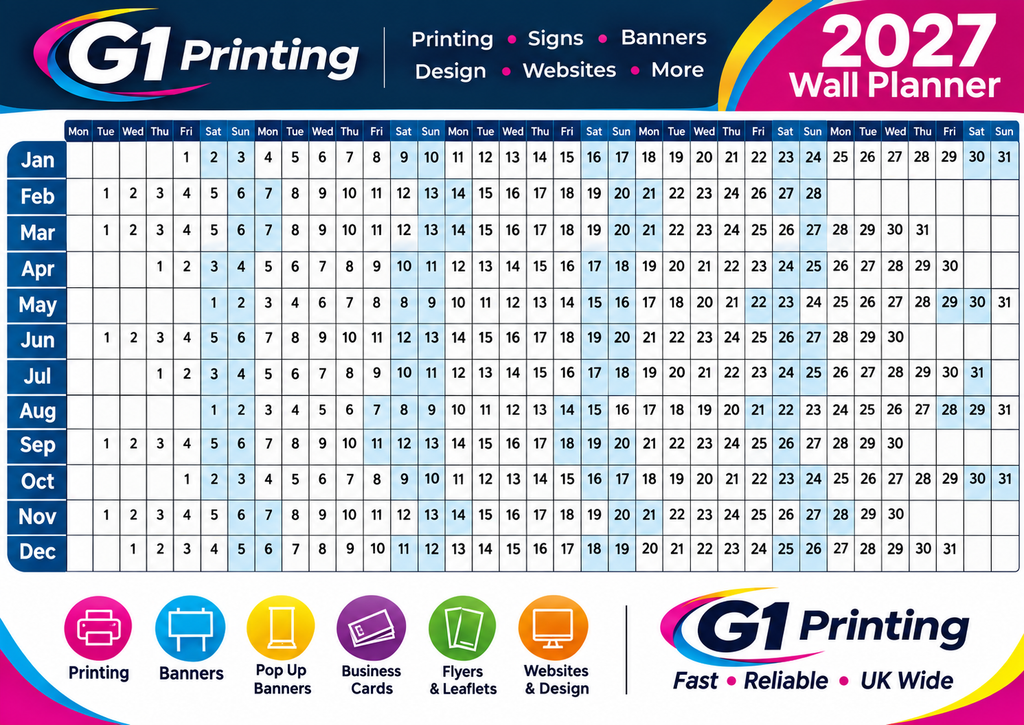
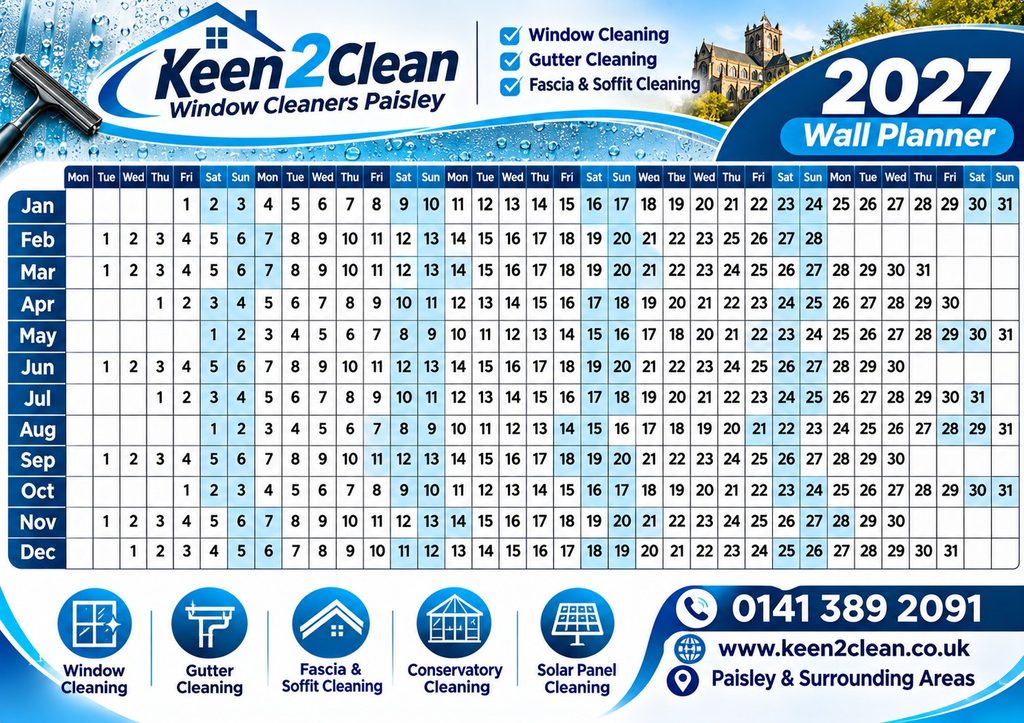
Wall Planners Printed and Delivered UK Wide: The Complete Buyer’s Guide
By G1 Signs, printers since 2005
If you run a busy workplace, a school, a shop, a warehouse or a lively family home, you know the problem. Dates slip. Holidays clash. Deadlines creep up on you. A good wall planner fixes all of that by putting the whole year, month or week in plain sight, where everyone can see it without logging in to anything.
Printed wall planners are one of the simplest and most useful tools you can hang on a wall. They cost very little compared with the time they save, they never run out of battery, and they work for every member of the team, whatever their level of tech skill. More and more UK businesses are now ordering custom wall planners that carry their own logo, their own layout and their own colours, so the planner does two jobs at once: it keeps people organised, and it keeps the brand in view all year.
This guide explains everything you need to know before you order. You will learn about the different types of wall planner, the main sizes, the best paper and finishes, how much printed wall planners usually cost, and how delivery works when your planner is printed in one place and sent anywhere in the UK. By the end, you will know exactly what to ask for and how to get a planner that looks sharp and works hard.
What Is a Wall Planner?
A wall planner is a large printed chart that shows a period of time on one sheet. Most people think of the yearly wall planner, which shows all twelve months in a single view, so you can see the whole year at a glance. But wall planners come in many forms. Some show one month. Some show one week. Some are built for tracking staff holidays, shift patterns, school terms or project stages.
The main idea is the same in every case. A wall planner gives you a big, clear picture of time. You can write on it, stick labels to it, colour it in and mark it up. Everyone who walks past can read it in seconds.
Wall planners are sometimes called year planners, yearly planners, annual planners, wall charts or wall calendars. The names overlap, but there is a small difference. A wall calendar usually shows one month per page and often has a picture. A wall planner usually shows more days on one sheet and leaves more room to write. If your goal is to plan rather than to decorate, a planner is the better choice.
Why Choose a Printed Wall Planner Over an App?
Digital calendars are handy, but they have one big weakness. You have to open them. A printed wall planner is always on, always visible and always shared. Here are the main reasons so many UK businesses still rely on a printed planner.
Everyone sees the same thing. When a plan lives on a wall, the whole team sees it at the same time. There is no chance of one person working from an old version.
It shows the big picture. A screen shows a few days at a time. A yearly wall planner shows 365 days together, so clashes, busy spells and quiet spells jump out straight away.
It is quick. Writing a date on a planner takes a few seconds. There is nothing to log in to, nothing to update and nothing to install.
It works in any workplace. Warehouses, workshops, shop floors, staff rooms, classrooms and site offices are not always good places for screens. A wall planner works anywhere there is a wall.
It makes planning feel real. People tend to take a date more seriously when they can see it written in pen or marked with a sticker. A visible deadline is harder to ignore.
It doubles as advertising. A custom printed wall planner with your logo, phone number and website can stay on a customer’s wall for twelve months. Few other promotional items get that much daily attention.
That said, a printed planner and a digital calendar work very well together. Many teams keep the main plan on the wall and copy key dates into their phones. The wall planner gives the overview, and the phone gives the reminders.
The Main Types of Wall Planner
The right planner depends on what you need to track. Here are the most common types people order.
Yearly Wall Planners
The classic. A yearly wall planner runs from January to December and shows every month on one sheet. It is ideal for spotting busy periods, planning holidays and keeping track of key dates such as trade shows, inspections, product launches and deadlines. Many people search for a 2027 wall planner at this time of year, because ordering early means the planner is ready on the wall before the new year begins.
Academic Year and Fiscal Year Planners
Not every year starts in January. An academic year wall planner usually runs from September to August, which suits schools, colleges, nurseries and universities. A fiscal year planner follows the financial year, which in the UK runs from April to March for most businesses. If your calendar does not match the standard year, a custom printed planner lets you choose any start month you like.
Staff Holiday and Annual Leave Planners
One of the most popular uses of all. A staff holiday planner, also called an annual leave planner or staff planner, has a row for each team member and a column for each week or day. Managers can see at a glance who is off, who is in and where cover might be thin. For any business with more than a handful of staff, this kind of planner prevents awkward clashes and last-minute scrambling.
Monthly and Weekly Planners
If you need more detail, a monthly wall planner gives you one large page for each month, with big boxes for each day. A weekly wall planner goes further and breaks the week into hours or sessions. These are common in busy offices, salons, garages, kitchens and clinics, where the schedule changes quickly and detail matters.
Project Planners and Gantt-Style Charts
A project wall planner lays out tasks along a timeline. You can see when each stage starts and finishes, which jobs overlap and where delays may cause trouble. Building firms, design teams, marketing teams and event planners often use these to keep large projects on track.
Shift and Rota Planners
If your team works shifts, a shift planner lists each person against each day and shift pattern. It is a clear way to share a rota with a whole team without sending dozens of messages.
Undated Planners
An undated wall planner has blank date boxes that you fill in yourself. It can be used again and again, and it suits businesses that plan in cycles rather than calendar years. It also works well for event planning, where you may be counting down to a day rather than looking at a fixed calendar.
Family and Home Planners
Not all wall planners are for business. A family planner has columns for each family member, so everyone can see school events, clubs, appointments and birthdays in one place. These are popular in kitchens and hallways, and they take the stress out of busy household schedules.
Wall Planner Sizes: A1, A2, A3 and Custom
Size matters more than most people expect. A planner that is too small leaves no room to write. One that is too big may not fit the wall. Here is a simple guide to the standard sizes.
A3 wall planners (297 x 420mm). A neat size for desks, small offices and notice boards. Good for monthly or weekly planners, personal planning and smaller teams. Writing space is limited on a full-year layout, so A3 is best for simple plans.
A2 wall planners (420 x 594mm). A good middle size. A2 is big enough to show a full year with decent writing space, but small enough to fit on most office walls, behind a door or beside a desk. It is a very popular choice for small teams and home offices.
A1 wall planners (594 x 841mm). The classic big planner. A1 gives you generous date boxes, room for several lines of notes and good visibility from across the room. It is the usual choice for staff holiday planners, project planners and busy shared spaces.
A0 and larger. For large teams, control rooms or open plan offices, a bigger planner can be printed. At this size, you can include a lot of detail and still read it from a distance.
Custom sizes. If you have a fixed gap on the wall, or you want a long thin planner for a corridor, a printer can often make a bespoke size. Always measure your wall first, and allow some space around the edge.
A useful rule is to think about how many people will write on the planner and how much each person needs to write. A planner for ten staff with only holiday dates needs less space than a project planner with lots of notes. When in doubt, go one size up. It is rarely a mistake to give yourself more room.
Portrait or Landscape?
Landscape layouts, which are wider than they are tall, suit yearly planners where months run across the page. Portrait layouts, which are taller than they are wide, suit planners where months run down the page, and they fit neatly on narrow walls and beside doors. Choose the orientation that matches your wall space and the way you like to read dates.
Paper, Finish and Lamination: Getting the Quality Right
Two planners can look the same on screen and feel completely different on the wall. The paper and the finish make the difference.
Paper Weight
Paper weight is measured in grams per square metre, or gsm. A higher number means thicker paper. For wall planners, 150gsm and 170gsm are common choices. They are sturdy enough to hang flat, thick enough to write on and light enough to roll into a tube for delivery. Anything much thinner can curl, wrinkle or show through when you write on it. Anything much thicker can be hard to roll without leaving a kink.
Silk, Matt or Uncoated?
Silk paper has a smooth, lightly coated surface with a soft sheen. Colours look rich, and ballpoint pens write well on it. It is a very popular choice for custom wall planners.
Matt paper has no shine at all, so it avoids glare under office lights. It is a good choice if your planner hangs near a window or under strong spotlights.
Uncoated paper feels more natural and takes pencil and felt tip pens very well. It suits a simple, practical look, though colours may appear a little softer.
A good tip is to think about what people will write with. If your team uses ballpoint pens, silk or uncoated is fine. If you want to use wet wipe or dry wipe pens, you will need lamination, which we explain below.
Laminated Wall Planners
A laminated wall planner has a clear plastic layer that protects the paper and lets you write on it with a dry wipe or wet wipe pen. When plans change, you wipe the entry away and write the new one. This is perfect for staff holiday planners, shift planners and any chart that changes often.
Lamination also protects the planner from spills, grease, fingerprints and damp. For workshops, kitchens, garages and warehouses, it can make the difference between a planner that lasts a month and one that lasts all year.
Eco-Friendly Options
Many businesses now ask for recycled paper or paper from responsibly managed forests, such as FSC certified stock. It is worth asking your printer what options are available. Choosing sustainable paper is a simple way to show customers and staff that you care about the environment, and it costs little or nothing extra in many cases.
Colour and Print Quality
Wall planners are printed in full colour on modern digital or litho presses. For a single planner or a small run, digital printing is quick and flexible. For larger runs, litho printing is often more economical, and it gives very even, consistent colour across hundreds of sheets. A good printer will tell you which route suits your order.
For best results, make sure any logos and images are high resolution. A logo that looks fine on a screen can look blurry when it is blown up to A1. Vector artwork, such as a PDF or AI file, is ideal, because it stays sharp at any size.
Custom Printed Wall Planners for Business
A branded wall planner is one of the smartest low cost marketing tools a business can use. Think about how a typical promotional item works. A pen gets lost. A mug sits in a cupboard. A planner goes on the wall, and people look at it every day.
Staff Planners With Your Branding
For internal use, a custom wall planner can carry your company name, your logo and your brand colours, along with the exact layout your team needs. You might include columns for departments, rows for named staff, marked bank holidays and your own key dates such as stock takes, audits or company events. A planner made around the way your business actually works is far more useful than a generic one from a shop.
Promotional Wall Planners for Customers
Many companies print wall planners as year-round gifts for customers and suppliers. Trades, estate agents, accountants, garages, builders, schools, charities and local shops all use this idea well. Your logo, phone number and web address sit on the planner, and the planner sits on your customer’s wall. When they need your service, you are already right there in front of them.
The larger area of a wall planner gives you far more space for branding than a small pocket calendar. You can include a short message, a list of services, a map, a QR code or a seasonal offer.
Ideas for Your Planner Design
- Put your logo in a clear position at the top, with your phone number and website in the footer.
- Mark UK bank holidays and, if you work with Scottish customers, Scottish bank holidays too.
- Add key dates for your industry, such as trade shows, tax deadlines or school term dates.
- Include a small box for notes.
- Use a calm background colour so handwriting stays easy to read.
- Add a QR code that links to a page on your website.
Ordering for Several Sites or Teams
If you manage several branches, depots or classrooms, ordering the same planner in bulk saves time and money. Printing a batch together also helps keep colour and layout identical across every location. Ask your printer about quantity prices, because the cost per planner usually falls as the order grows.
What to Include on a Wall Planner
A great planner is clear, uncluttered and easy to write on. Here are the key features to look for or ask for in a custom design.
Clear date boxes. Boxes should be large enough for at least a short note. Tiny boxes lead to cramped handwriting and mistakes.
Highlighted weekends. Light shading for Saturdays and Sundays helps people find working days quickly.
Week numbers. Useful for businesses that plan by week number, especially in manufacturing, logistics and project work.
Bank holidays. Marked in a different colour or with a small label, so nobody books work on a day the business is shut. For UK wide use, remember that bank holidays differ between England, Scotland, Wales and Northern Ireland, so check which ones apply to your team.
Space for names. For staff planners, leave a clear column for each person’s name. Think about how many team members you have now and how many you may add during the year.
Colour coding. A simple colour key, such as green for holiday, blue for training and orange for sickness, makes a busy planner much easier to read.
Room to grow. Leave a few spare rows or boxes for new staff, new projects or last-minute changes.
A clean, readable font. Keep fonts simple and large enough to read from a short distance. Fancy scripts may look pretty, but they are hard to read on a busy chart.
How Much Do Printed Wall Planners Cost?
The price of a printed wall planner depends on several things: the size, the paper, whether it is laminated, how many you order and how complex the design is. To give you a rough idea of the UK market, online printers currently advertise single large format wall planners, such as A1 or A2 on 150gsm or 170gsm paper, from around £17 to £18 for one copy. Ready made staff planners from stationery brands usually sell for roughly £9 to £30 each, depending on size and mounting. Prices change from year to year, so always check a current quote.
Here is what usually pushes the price up or down.
Quantity. The more you order, the less each planner costs. Setup costs are shared across the whole run.
Size. An A1 planner uses much more paper and ink than an A3 planner, so it costs more.
Paper weight. Heavier stock costs more than lighter stock, though the difference is often small.
Lamination. Adding a protective laminate or a dry wipe finish adds to the price, but it also adds to the life of the planner.
Design work. If you supply print ready artwork, you pay only for printing. If you need help designing the layout, there may be a design fee.
Delivery. Some printers include delivery in the price, some charge a flat rate and some offer free delivery over a set order value. Always check what is included before you compare prices.
The cheapest planner is not always the best value. A thin sheet that curls, tears or fades by March is no bargain. It is better to pay a little more for a planner that lasts the whole year and looks professional on the wall.
How UK Wide Delivery Works
One of the biggest advantages of ordering from a professional printer is that you do not need to live nearby. A good print company can produce your planner in one place and send it to any address in the UK, from the Highlands to Cornwall, and from Belfast to Norwich.
Rolled, Not Folded
Large wall planners are normally sent rolled inside a strong cardboard tube. This matters. A folded planner ends up with creases that never fully drop out, and it can look tired before you even hang it. A rolled planner arrives flat and crease free, ready to go straight on the wall.
Some smaller planners, such as A3 or A4 sizes used for promotion, may be folded and sent in a box or envelope. If a crease free finish matters to you, ask for rolled delivery.
Delivery Times
Turnaround depends on the size of the order, the finish and how busy the print room is. A single planner on standard paper can often be printed quickly. Laminated, mounted or large bulk orders take longer. Because many people want their planners before the new year starts, the weeks from November to January are the busiest time of year for planner printing. If you want yours on the wall on 1 January, order well ahead.
Delivery Options
Most UK printers offer standard delivery, with faster options for urgent jobs. If you are in a hurry, ask about next day or timed delivery. Remote areas, such as the Scottish Highlands and Islands, Northern Ireland and some island locations, can occasionally take an extra day or cost a little more, so it is wise to check before you order.
Sending Planners to Several Addresses
If you are ordering for different sites, ask whether the printer can split the order and send planners straight to each branch. This saves you the trouble of re-packing and posting them yourself.
Checking Your Order on Arrival
When your tube arrives, open it soon after, unroll the planner and check it for damage or print errors. If something is wrong, contact your printer straight away. Keep the tube and packaging until you are happy, in case a replacement is needed.
How to Order Your Printed Wall Planner Step by Step
Ordering a custom wall planner is simpler than most people think. Here is a straightforward route from idea to wall.
Step 1: Decide what the planner is for. Is it for staff holidays, project tracking, customer gifts or family use? The purpose decides the layout, size and finish.
Step 2: Choose the dates. Pick a calendar year, an academic year, a fiscal year or an undated format.
Step 3: Pick a size. Measure your wall and think about how many people will write on the planner.
Step 4: Choose the paper and finish. Silk or matt for writing with ballpoint pens, laminated for dry wipe use.
Step 5: Prepare or request your artwork. Send a print ready PDF if you have one. If not, ask the printer for design help. Supply your logo as a high resolution or vector file.
Step 6: Check the proof. Read every date, every name and every number on the proof. Check the spelling of your business name and the phone number. This is the cheapest moment to fix an error.
Step 7: Confirm quantity and delivery. Tell the printer how many planners you need and where to send them.
Step 8: Receive and hang. When your planner arrives, unroll it, let it rest flat for a short while and put it up.
Hanging and Using Your Wall Planner
A planner is only useful if it is up, straight and easy to reach. Here are a few simple tips.
Pick the right spot. Hang the planner where people already pass and pause, such as near the kettle, by the door or next to the manager’s desk. Aim for eye level so everyone can read and write on it without stretching.
Use the right fixings. Reusable adhesive mounting pads are popular because they do not mark paint. For heavier or laminated planners, use poster strips, magnetic strips or a proper hanging rail. Poster hangers with a top and bottom bar keep the sheet flat and straight.
Keep pens close. Tie a pen to the planner on a string or place a pen pot beside it. A planner with no pen nearby soon stops being used.
Agree the rules. Decide as a team what goes on the planner, who updates it and how colours or stickers are used. A shared system makes the whole thing work.
Review it often. Spend a few minutes at the start of each week or month looking at the planner together. This small habit is what turns a wall planner from decoration into a real management tool.
Protect it. Keep it away from direct sunlight, which can fade ink, and away from radiators, which can dry out and curl the paper.
Common Mistakes to Avoid When Buying Wall Planners
A little care can save you money and frustration. Watch out for these common mistakes.
Ordering too small. A planner that looks great on screen can be tiny on the wall. Check the real dimensions, and compare them with something you know.
Using low resolution artwork. A fuzzy logo spoils the whole planner. Always send the best quality file you have.
Forgetting the dates. Check that weekends fall on the right days, that leap years are handled properly and that bank holidays are correct for your region.
Ignoring regional differences. Scotland, England, Wales and Northern Ireland do not share every bank holiday. If you have staff in more than one nation, make sure the planner shows the right dates.
Skipping the proof. Always read the proof carefully. A wrong date or phone number on a run of 500 planners is an expensive lesson.
Leaving it too late. Planner printing peaks in the weeks before the new year. Order early to avoid delays and to give yourself time to approve the design.
Choosing on price alone. Compare paper weight, finish, delivery and proofing as well as the headline price.
Frequently Asked Questions About Wall Planners
What size is best for a wall planner?
For most offices, A2 or A1 works best. A2 suits small teams and home offices. A1 suits larger teams and busy shared spaces. A3 is fine for simple plans or smaller spaces.
Can I get a wall planner printed with my own logo?
Yes. Custom printed wall planners can carry your logo, your colours, your contact details and a layout made for your business. Send a high resolution or vector logo for the sharpest result.
Can I write on a wall planner with a normal pen?
On silk, matt or uncoated paper, ballpoint pens and fine felt tips usually work well. For wipe clean use, ask for a laminated planner and use a dry wipe or wet wipe pen.
Will my wall planner arrive creased?
Large planners are normally delivered rolled in a tube so they arrive flat and crease free. If crease free delivery matters to you, say so when you order.
Do you deliver wall planners across the UK?
Yes. We print in Glasgow and deliver planners to addresses throughout the UK, including England, Scotland, Wales and Northern Ireland.
How early should I order a 2027 wall planner?
As early as you can. Most people order in the autumn so the planner is ready before the new year. Orders placed late in December can be tight, especially for laminated or bulk jobs.
Can I order a wall planner that starts in a different month?
Yes. Academic year planners starting in September and financial year planners starting in April are both common, and a custom printed planner can start in any month you choose.
How many staff can a holiday planner hold?
That depends on the layout and size. Ready made holiday planners often fit around 30 staff names on a mid size sheet. A custom design can be built for any number of people, so tell your printer your headcount and they can size the planner to match.
Is a wall planner better than a wall calendar?
It depends on your goal. A wall calendar is best for looking at one month at a time and often features a picture. A wall planner shows far more of the year at once and leaves more room to write, so it is better for planning.
Can I order just one wall planner?
In most cases, yes. Digital printing means you can order a single planner or a small batch without paying for a large run.
Is a Custom Wall Planner Worth It?
For most businesses, the answer is a firm yes. Think about the cost of a missed deadline, a double booked day or a team member who forgot a training session. A single mistake can cost more than a whole run of planners. When you add the marketing value of a branded planner on your customers’ walls, the return is hard to beat.
The key is to choose a planner that fits the way you work. Choose the right size, the right layout and the right finish, and your planner will be used every day for the whole year.
Get Your Wall Planners Printed and Delivered Across the UK
G1 Signs has been printing in since 1985. We print wall planners to your size, your layout and your branding, and we send them rolled and ready to hang to addresses anywhere in the UK. Whether you need one planner for your office or hundreds for your customers, we can help you choose the right paper, finish and quantity.
Call us on 0141 374 2615 or visit g1signs.co.uk to ask for a quote. Tell us the size, the quantity and the dates you need, and we will do the rest.