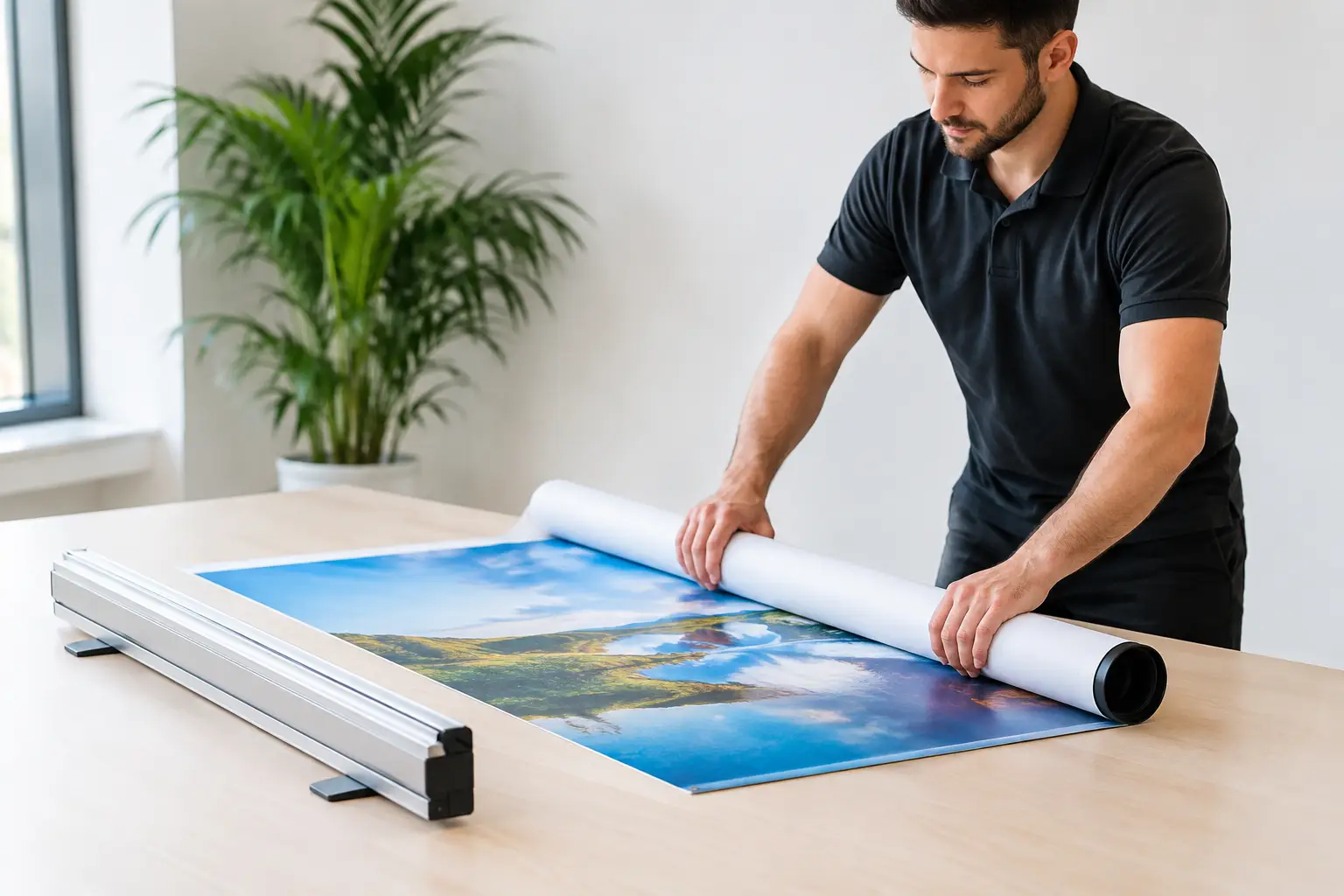
A roller banner that will not retract properly is usually discovered at the worst possible moment: when the stand is packed down after a busy exhibition, a client meeting or a retail promotion. Knowing how to roll up banners correctly protects the printed graphic, keeps the cassette working as it should and means your display is ready for the next event.
The key point is simple. A standard pull-up banner is designed to retract into its base under controlled tension. You should guide it down slowly rather than try to roll the material by hand. Rushing this part can crease the banner, mark the print or put unnecessary strain on the mechanism.
How to roll up a roller banner safely
Start by making sure the banner is standing upright on a clean, dry and level surface. Remove any promotional materials, tape or clips that may be attached to the graphic. If the banner has collected dust during the event, wipe it gently with a soft, dry microfibre cloth before packing it away. Dirt trapped inside the base can rub against the print during transport.
Hold the top rail firmly with both hands. Keep it level and pull it very slightly upwards first, just enough to release pressure from the support pole or hook. Then unhook the top rail from the pole and keep hold of it at all times. Do not let it snap back into the cassette.
Guide the banner down slowly and evenly towards the base. Keep the top rail parallel with the cassette opening as it retracts. This prevents one side feeding in faster than the other, which is a common cause of edge creases and uneven rolling. If you feel resistance, stop immediately. Pull the graphic back up a short distance, check that it is straight, and try again at a slower pace.
When the banner is fully inside the base, remove the support pole and place it in its protective sleeve if supplied. Fold in the stabilising feet on the base, then put the banner into its carry case. Zip the case fully before moving it. This takes seconds but makes a real difference when banners are loaded into cars, stored in stockrooms or transported between venues.
Never force the banner into the cassette
A roller banner base contains a spring-loaded mechanism. It is reliable when treated properly, but it is not designed to absorb sudden movement. Letting the top rail fly back can damage the graphic, weaken the spring or cause the rail to strike the base.
The same applies if the material stops halfway down. Do not push it into the cassette, fold the print or press down hard on the top rail. A minor alignment issue can become a damaged banner very quickly. Instead, pull the banner gently back to its full height, ensure the graphic is centred, and guide it down again.
If the banner repeatedly jams, retracts unevenly or has a visibly loose edge, it may need attention before its next use. Continuing to force the mechanism can turn a fixable problem into a replacement cost. For a time-sensitive event, replacing a faulty unit is often the safer option than arriving with a display that cannot be set up cleanly.
The right way to pack a banner after an event
Packing a banner properly matters as much as rolling it up. A carry case protects the base from knocks, but it also helps protect the printed panel from dust, moisture and pressure from other event equipment.
Before putting the banner away, check four areas: the top rail is fully closed, the printed graphic has retracted evenly, the pole is secure in its sleeve, and the stabilising feet are folded flat. If the banner has been used outdoors or near an entrance, make sure it is completely dry. Packing a damp banner can lead to marks, odours and deterioration of the print over time.
Avoid placing heavy boxes, exhibition stands or tools on top of the carry case. While the case is designed for day-to-day transport, the banner mechanism can still be damaged by excessive weight. Where possible, transport the case flat or upright, rather than leaving it loose where it can slide around in a vehicle.
For businesses that use the same display regularly, label the carry case with the campaign, event name or department. It is a small organisational step that saves time when several banners are being prepared for a trade show, conference or pop-up promotion.
What if the printed banner has come out of the base?
Sometimes the question of how to roll up banners means dealing with a graphic that has detached from the roller mechanism. This can happen after heavy use, an accidental pull beyond the intended height, or damage during transport.
Do not attempt to wind the banner around the internal roller unless you are confident with the mechanism. The spring inside the cassette is under tension and an incorrect repair can be difficult and unsafe. It may also leave the graphic misaligned, so it retracts badly even if it appears to work at first.
If only a small section has lifted, avoid using adhesive tape as a quick fix. Tape can create a thicker edge that catches in the cassette and may leave residue on the printed material. A specialist repair may be possible depending on the banner system and the condition of the graphic, but for an urgent campaign a new roller banner can be the more practical choice.
Prevent creases, curls and print damage
Most roller banner damage happens through hurried setup and pack-down, not through normal use. Give the banner a little space when you retract it and avoid packing it immediately after people have brushed past it, spilled drinks nearby or handled it with dirty hands.
Creases are particularly noticeable under exhibition lighting. To reduce the risk, always keep the graphic taut during setup and retract it straight into the base. Never fold the printed panel by hand. If a light curl develops at the edges after long-term storage, set the banner up several hours before the event where possible. This gives the material time to settle under its own tension.
Store roller banners in a dry indoor space away from radiators, direct sunlight and extreme cold. Heat can affect print materials and adhesives, while damp storage can mark both the graphic and the case. If you only use your banners a few times a year, take them out and check the mechanism before the day of the event rather than waiting until the morning you need them.
When to replace a roller banner
A quality roller banner can support repeated use, particularly when it is rolled up and carried correctly. However, the right replacement point depends on how often it travels, how heavily it is used and how visible your display needs to be.
Consider replacing the banner if the mechanism is unreliable, the print has deep creases, the edges are fraying, or your offer, branding or contact details are out of date. A banner that looks tired can undermine an otherwise professional stand. For customer-facing events, a clean, current display is a straightforward way to make your business look prepared.
If deadlines are tight, G1 Printing can produce event-ready roller banners for businesses that need a practical, portable display without unnecessary delay. Supplying print that is ready to use is useful, but keeping it in good condition after each event protects that investment.
A quick check before your next event
Set your banner up once before it leaves the office, shop or venue store. Check that the support pole locks securely, the graphic rises smoothly and the base sits level. This quick test gives you time to deal with a problem before you are standing in an exhibition hall with doors about to open.
Treat the top rail as the handle, guide the graphic down slowly and keep the carry case close by. A roller banner is one of the simplest ways to promote a business in person, and a careful pack-down helps ensure it looks just as sharp at the next opportunity.