A stand can be booked months ahead and still become a last-minute print job. The floor plan changes, a sponsor logo arrives late, prices need updating, or someone notices the roller banner still carries last year’s message. This guide to event print deadlines gives UK event teams a practical way to plan print without paying for avoidable rushes or risking materials arriving after the doors open.
The right deadline is not simply the day you need your banners, flyers or posters. It is the point at which approved artwork, production time, dispatch and a delivery buffer all fit comfortably before your event. Treating that date seriously keeps your marketing visible, your team calmer and your budget under control.
Start With the Event Date, Then Work Backwards
Put the event opening time in your diary, then work back from the moment your printed materials must be at the venue. For a trade show, that may be build-up day rather than the first public day. For a retail promotion, it may be the evening before installation. For a conference, allow time to sort delegate packs, position signage and check every display before attendees arrive.
Your working deadline should include four stages: final artwork approval, print production, dispatch or collection, and a contingency period. The contingency matters because event logistics rarely run exactly to plan. A venue may restrict delivery hours, a courier may need a named contact, or an organiser may move your stand at short notice.
As a sensible rule, aim to have standard event print in hand several working days before set-up. Larger, more complex or higher-value displays deserve more time. Same-day and fast-turnaround printing can rescue a genuine emergency, but it should not be the plan for every job.
A Guide to Event Print Deadlines by Product
Different products carry different production and handling risks. A small batch of business cards is usually easier to replace than a large branded backdrop. Plan according to what would cause the biggest problem if it were missing.
Flyers, leaflets and business cards
These are often the simplest items to produce, but they are also the items teams leave until last. Final speaker details, discount codes and event schedules can hold up approval. If the content is likely to change, create a version with only the essential details and leave variable information for a digital channel or a small overprint where practical.
Order enough for the expected footfall, but be realistic about how they will be used. A focused handout for qualified visitors can perform better than thousands of generic flyers. Keep a small reserve for staff, partners and late opportunities.
Posters and PVC banners
Posters and banners are effective for directions, offers, launch messaging and stand visibility. Their deadline depends on size, finishing and where they will be installed. A PVC banner may need eyelets, hemming or a specific size to fit an existing frame. A poster may require a weatherproof display case or mounting board.
Before sending artwork, confirm the visible area, fixing points and any venue rules. A banner that arrives on time but is too wide for the allocated space is still a problem. Measure twice and allow for pole pockets, eyelets and safe clearance around doors, fire exits and walkways.
Roller banners, pop-up displays and backdrops
Portable displays are built for events, but they require more careful planning because they are prominent and often cannot be substituted easily on the day. Check the supplied template, safe area and bleed requirements. Keep key text, QR codes and logos away from edges, cassette areas and joins.
For step-and-repeat backdrops, confirm the final sponsor list early. Every late logo amendment can create a new proofing cycle, and a branded media wall is one item where errors are highly visible in photographs. Where possible, set a sponsor artwork cut-off date that is earlier than the print deadline.
Set One Artwork Cut-Off, Not Several Vague Promises
The phrase “we need it soon” is how event print gets delayed. Give everyone involved a clear artwork cut-off with a time and date. This applies to your designer, marketing lead, client, sponsor and anyone supplying logos, copy or legal approval.
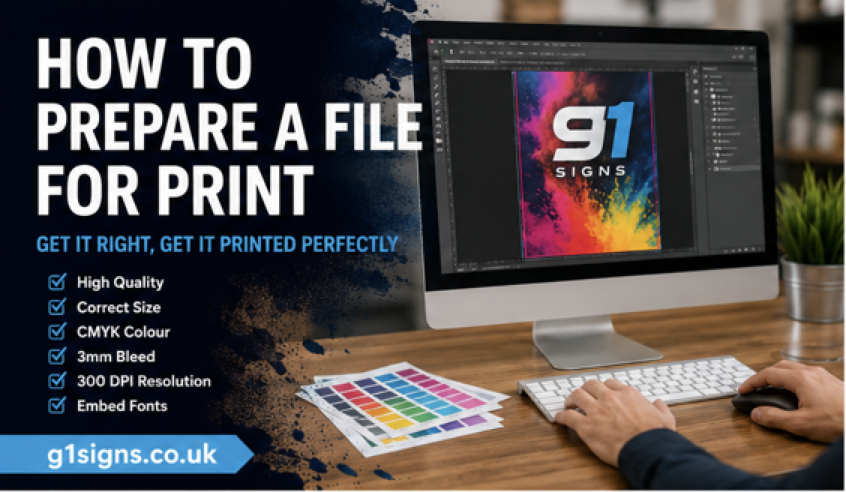
Build the cut-off around complete, print-ready files rather than an informal design draft. A file may look finished on screen but still need corrected bleed, missing fonts, higher-resolution images or a properly defined size. Last-minute fixes are manageable when they are minor. They become expensive when a whole design needs rebuilding.
Nominate one person to give final approval. Too many reviewers can create conflicting feedback and repeated amends. For larger events, maintain a simple print schedule showing each item, quantity, specification, artwork owner, approval status, print deadline and delivery location. It does not need to be complicated. It just needs to show what is outstanding before it becomes urgent.
Prepare Artwork That Can Go Straight to Print
Fast production relies on usable files. Supply artwork at the correct finished size, with the required bleed and a safe margin for important information. Use high-resolution images and ensure brand colours are set up for print where required. Small logos pulled from a website often look acceptable on a laptop and poor on a two-metre backdrop.
Check every detail that visitors will see: dates, times, stand numbers, telephone numbers, web addresses, QR codes and prices. Scan a QR code from a proof on a phone, rather than assuming it works. If your event is outdoors, consider viewing distance, weather and lighting. Large, high-contrast wording usually works harder than a crowded design full of small copy.
Ask for a proof when the job is complex, brand-sensitive or includes variable data. Proofing adds a step, so it must be included in your schedule. It is still far quicker than discovering an incorrect date across hundreds of leaflets or a logo positioned incorrectly on a display wall.
Plan Delivery Around the Venue, Not Just Your Office
A reliable delivery address is essential, but an event venue can be less straightforward than a normal workplace. Find out whether deliveries are accepted before build-up, whether goods must be labelled with the stand number, and whether there is a loading bay or service entrance. Some venues will refuse unlabelled parcels, charge handling fees or only accept deliveries during limited hours.
If you are sending print directly to the venue, provide a named contact who will be on site. Include the event name, hall, stand number and mobile number wherever possible. For valuable display materials, consider having goods delivered to your office or home first if time allows. You can check the order, pack it with your event kit and take control of the final journey.
Collection can be the best option for urgent London and local jobs, particularly when a courier window is too tight. However, it only helps if someone has been assigned to collect it and has suitable transport. A wide PVC banner, a pop-up display case and several boxes of flyers may not fit into the car that was available for a small parcel.
Use Rush Printing for Real Emergencies
Same-day printing is valuable when an unexpected change genuinely cannot wait: a replacement banner, revised pricing, a corrected poster or a new batch of handouts for a packed event. It can save a campaign and protect a professional appearance. G1 Printing supports fast-turnaround event materials for businesses that need to move quickly.
That said, rush production has trade-offs. Your choice of stock, finish, quantity or delivery method may be narrower, and there is less time to proof thoroughly. The closer you get to the event, the more every unanswered email, incorrect file and missed courier cut-off matters. Use urgent service to solve a specific problem, not to compensate for an unclear approval process.
Keep a Small Event Print Contingency
A contingency does not mean ordering everything twice. It means identifying the items worth protecting. Keep final approved artwork in one accessible folder, along with logos, fonts and contact details. Carry a few spare posters or flyers if they are easy to transport, and pack practical items such as cable ties, banner clips, tape permitted by the venue and a marker pen.
For multi-day events, hold back a portion of flyers rather than putting every copy out on day one. If an offer changes or stock runs low, you will know what needs reprinting and what can wait. The same approach works for regional roadshows, where the first event can reveal adjustments needed for later dates.
The best event print deadline is the one that gives your team time to check the job, not merely receive it. Set the artwork cut-off early, allow for venue logistics and keep fast printing available as your safety net. That way, your banners, displays and handouts arrive ready to do their job: get your business noticed.