When you need to order urgent event flyers, the deadline is rarely the only pressure. You may still be confirming speakers, finalising offers, booking staff or waiting for a venue plan. The right print order keeps one moving part under control: clear flyers, produced quickly, delivered where they need to be and ready to hand out.
For a product launch, exhibition, shop promotion, charity event or local campaign, urgency does not have to mean poor presentation. It does mean making fast, sensible decisions about artwork, quantity, stock and delivery. A few minutes spent checking the essentials can prevent costly reprints or a parcel arriving after your event has started.
When to order urgent event flyers
Start by working backwards from the time the flyers must be in your hands, not from the event date alone. If your team needs an evening to pack welcome bags, place flyers on tables or brief brand ambassadors, build that time into the schedule. A flyer delivered on the morning of an event may technically be on time, but it leaves no room for a delivery delay or a final check.
Fast print services can be a practical answer when plans change late, but available turnaround depends on the product specification, quantity, artwork readiness and order time. Same-day printing may be suitable for straightforward jobs, while larger quantities, specialist finishes or complex folding can require longer. If the deadline is fixed, choose a specification designed for speed rather than adding options that do not materially improve the campaign.
Be precise about your required delivery address. A city-centre office, exhibition hall, hotel reception and home address can all have different access rules. Include a contact number for the person who can receive the parcel, particularly where a venue has a loading bay, security desk or limited opening hours.
Prepare artwork before placing the order
The quickest way to hold up urgent printing is to submit artwork that needs correction. A flyer can look perfect on screen and still have problems at print size: a logo may be too low resolution, text may sit too close to the edge, or a background may leave an unwanted white border after trimming.
Use the right file setup
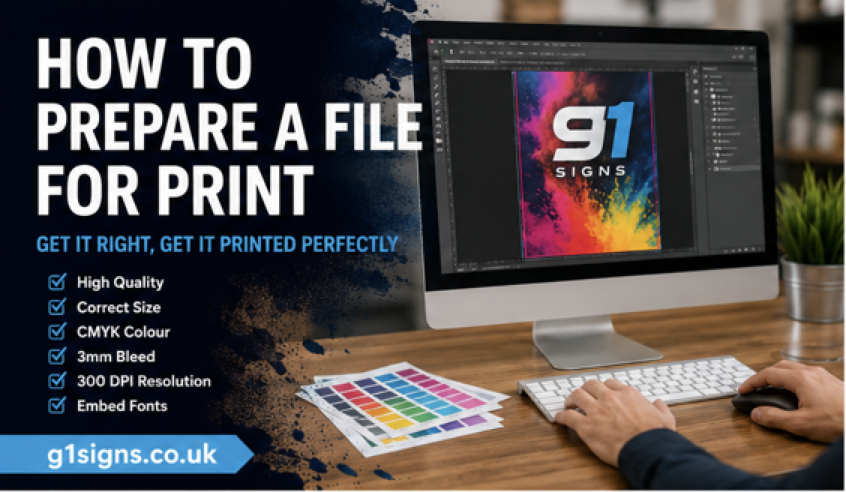
A print-ready PDF is normally the safest format for event flyers. Set the document to the final trim size and add 3 mm bleed on every edge where a colour, image or pattern runs to the border. Keep key text, contact details, QR codes and logos a few millimetres inside the trim line. This gives the cutting process reasonable tolerance without putting your message at risk.
Use high-resolution images, ideally 300 dpi at their printed size. Enlarging a small image from a website often produces a soft or pixelated result, especially on a full-colour A5 flyer. Where possible, supply artwork in CMYK rather than RGB so colours are closer to the expected printed result. Bright screen colours can appear different on paper, particularly vivid blues, greens and neons.
Before uploading, read every word once more. Check dates, times, addresses, ticket details, offer codes and telephone numbers. For an urgent run, a typo is more expensive than taking five extra minutes to proofread.
Keep the message visible at a glance
People often read event flyers while walking through a busy venue, browsing a counter or moving between meetings. Put the main reason to attend first. That might be a date, a limited offer, a headline act, a new product or free entry. The next line should tell readers where to go and what action to take.
Avoid filling every spare space with copy. A clear event title, date, location, concise benefit and a simple call to action will usually outperform a crowded design. If you use a QR code, make it large enough to scan easily and test it from a printed proof or at least from a screen at realistic distance.
Choose flyer size, paper and quantity for the job
A5 remains a dependable choice for many event campaigns because it gives enough room for strong imagery and practical information without feeling bulky. A6 is cheaper and easier to carry, making it useful for short offers, menu inserts or door drops. DL flyers suit invitations, service promotions and designs that need a more formal vertical layout.
Paper weight affects both budget and perception. A lighter stock can be the right option for a high-volume handout where reach matters most. A sturdier stock gives a more substantial feel for networking events, premium retail promotions or invitations that need to survive in a bag or pocket. Gloss finishes can make photographs and bold colours stand out, while silk or matt finishes are often easier to write on and can give a more restrained business look.
Quantity should reflect distribution, not optimism. Estimate how many people will realistically attend, pass your stand or receive a flyer, then include a sensible buffer for staff, partners and late demand. Ordering far too many may appear economical on a per-unit basis, but unused flyers are still wasted budget if the date or offer expires next week.
Build delivery into the turnaround plan
Printing quickly is only one part of an urgent order. Production time, dispatch timing and delivery all need to work together. If you need flyers for a Saturday event, waiting until Friday afternoon to confirm delivery can create unnecessary risk, even if the artwork is ready.
Choose the most practical delivery option available for your deadline and location, then make sure someone can accept it. For a trade show or conference, sending directly to the venue can save time, but only if the organiser permits deliveries and the parcel is labelled correctly. Some venues reject packages without a stand number, event name or named contact.
If your artwork or event details are still changing, decide on a final approval point. Once the print file is submitted, treat it as locked unless a change is genuinely essential. Last-minute adjustments can reset production timing and create confusion between different versions of the design.
Common mistakes when ordering urgent event flyers
Urgent orders tend to go wrong in predictable ways. Avoid these four issues and the process becomes much easier:
- Sending a file with no bleed, leaving a risk of white edges after trimming.
- Ordering a quantity based on venue capacity rather than likely footfall or distribution plans.
- Using tiny text, dense copy or an untested QR code that is difficult to read quickly.
- Giving a delivery address without checking venue opening times, access instructions or the receiving contact.
There is also a trade-off between speed and complexity. A simple, well-designed flyer on a standard stock can often be produced faster than a design requiring unusual sizes, folds or special finishes. For a one-off premium invitation, those details may be worth the extra lead time. For a time-sensitive promotion, clarity and availability usually matter more.
Match flyers with the rest of your event print
A flyer works harder when it looks consistent with the materials around it. Use the same event name, colours, offer and call to action across posters, roller banners, counter displays and stickers. This helps visitors recognise your campaign quickly, particularly at exhibitions and busy retail locations where several brands are competing for attention.
You do not need every item to carry every detail. Let a roller banner attract attention from distance, use posters for directional information, and let flyers carry the offer, timetable or takeaway message. G1 Printing can support this practical mix of fast event-ready print, helping teams keep their visual materials aligned without dealing with several suppliers.
Place an urgent order with confidence
A fast flyer order is most successful when the brief is simple and the file is ready. Confirm the final event details, choose a size and stock that suit the way the flyer will be used, set a realistic delivery deadline and proofread before submission. Then move quickly.
The best urgent flyers do not try to say everything. They give the right audience one clear reason to act, put the essential details in front of them and arrive early enough for your team to use them properly.