A banner has seconds to do its job. Whether it is standing beside a busy exhibition aisle, outside a shop, behind a speaker or at a local event, people need to understand the message before they walk past. Effective banner printing is not about filling every inch with information. It is about producing a clear, professional display that can be ordered quickly, transported easily and put to work straight away.
For businesses managing a promotion, launch or event deadline, the best choice depends on where the banner will be used, how often it will travel and what action you want people to take. Get those decisions right first and the design, size and material become much easier to choose.
Choose Banner Printing for the Job
The cheapest banner is not always the best value. A lightweight display can be ideal for a one-day indoor event, while a banner intended for repeated outdoor use needs a tougher material and secure finishing. Start with the setting rather than the artwork.
Roller banners for portable displays
Pop up roller banners are a practical choice for exhibitions, reception areas, presentations and sales meetings. The printed graphic rolls into its base, which protects it in transit and makes set-up quick. One person can usually carry and assemble it in minutes, making it useful when your team is arriving at a venue with limited time.
Roller banners work best with a simple layout: a strong logo at the top, one clear headline, a product image or key benefit in the middle, then contact details or a call to action near the bottom. Avoid placing vital text right at the base, where it can be less visible from a distance.
PVC banners for promotions and outdoor use
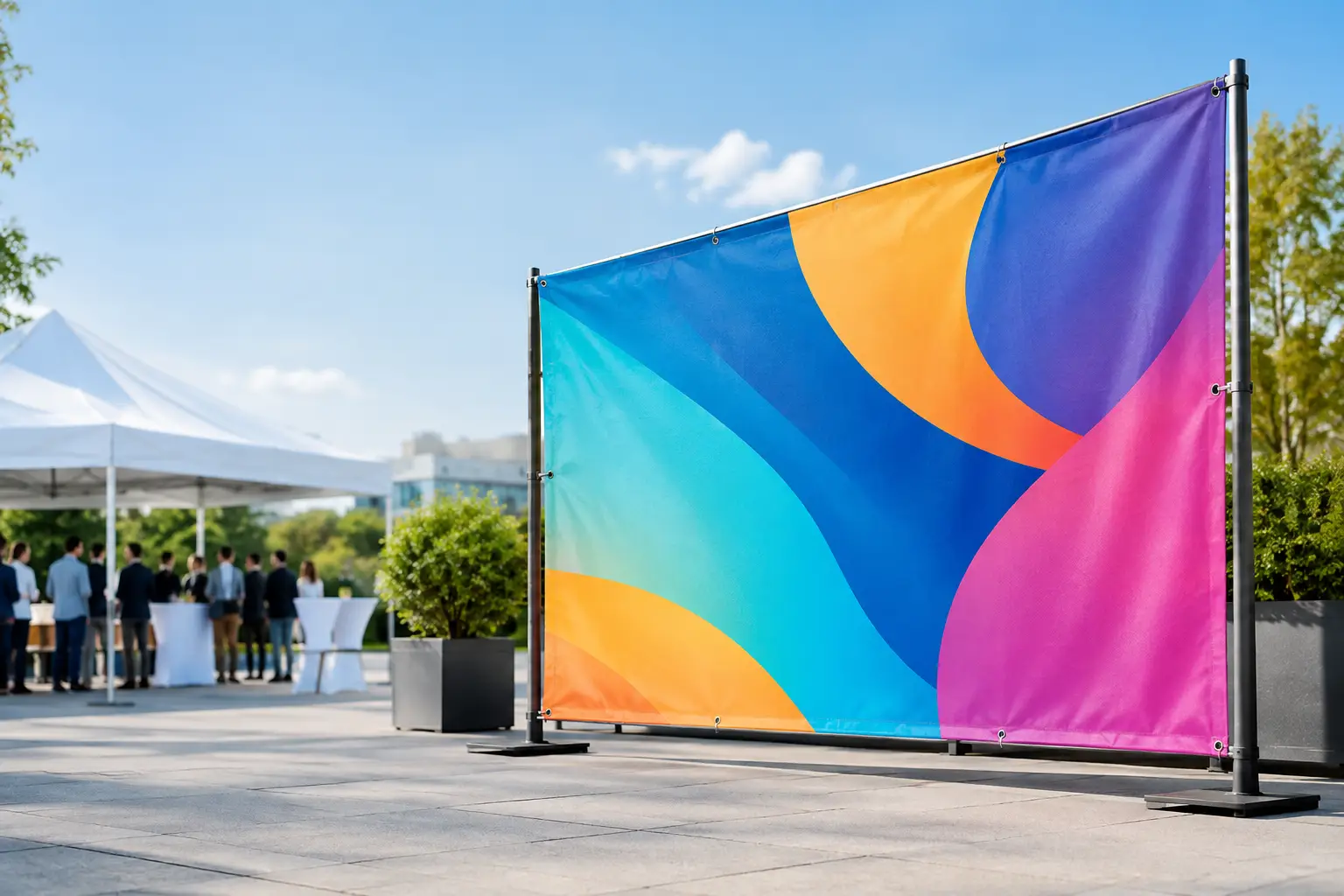
PVC banners are built for visibility across larger spaces. They suit shopfront offers, building sites, school events, sports days, community campaigns and outdoor promotions. With eyelets fitted around the edges, they can be fixed to railings, fences and frames.
Consider the wind exposure before ordering. A large banner in an exposed location needs suitable fixing points and secure tension. If it will be used outdoors for a prolonged period, ask for practical advice on material, finishing and the best way to install it. A loose banner looks untidy and can wear faster.
Step-and-repeat backdrops for branded photographs
A branded backdrop gives sponsors, organisations and event hosts a professional background for photographs. These displays are especially effective at award evenings, press events, launches, charity functions and product activations. Repeated logos should be spaced consistently, with enough room for people to stand in front without covering the entire design.
The main trade-off is between impact and practicality. A larger backdrop makes a stronger photographic statement, but you need to check the venue wall space, ceiling height and access route before choosing the size.
Make the Message Readable at a Glance
Most banner problems begin before printing. A design may look excellent on a laptop screen but fail when viewed from several metres away. People do not stop to read a paragraph while passing a stand or walking along a high street.
Use one main message. This could be an offer, service, event name or reason to visit your stand. Support it with only the details needed to act: a date, website address, telephone number, QR code or location. If every service, logo and price is given equal prominence, nothing stands out.
Think about viewing distance when choosing type size. A headline intended to catch attention across a room needs to be significantly larger than supporting text. Strong contrast matters too. Dark lettering on a light background, or light lettering on a dark background, is generally easier to read than similar tones sitting together.
Images need to earn their place. Use high-quality product photography, a bold campaign visual or a recognisable brand image, but do not use a busy picture merely as decoration. The image should support the message, not compete with it.
Prepare Artwork That Prints Cleanly
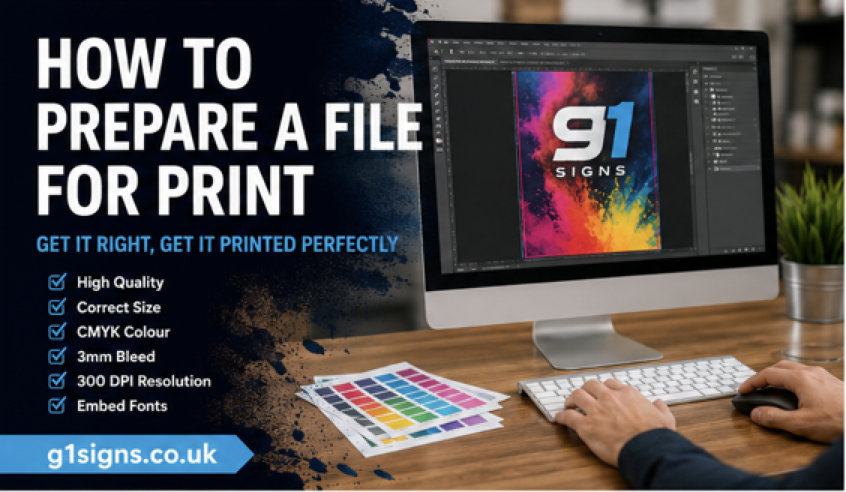
Banner printing can only reproduce the file supplied. A low-resolution image, incorrect dimensions or missing bleed can lead to delays and disappointing results, particularly when an order is needed quickly.
Build the artwork at the final print size wherever possible. If your design software works at a reduced scale, make sure the resolution remains suitable when enlarged. Raster images such as JPEGs and PNGs should be high resolution. Logos, text and simple graphics are often best supplied in vector format because they remain sharp at larger sizes.
Use CMYK colour mode for print artwork rather than RGB. Screens display colour using light, while print uses inks, so bright screen colours can look different on a finished banner. If your brand relies on a precise corporate shade, provide the relevant colour reference and allow time for advice where colour matching is particularly critical.
Keep important text, logos and QR codes inside a safe area. Banner edges may be hemmed, fitted with eyelets or held within a roller banner cassette. A small margin protects vital content from being too close to the edge or affected by finishing.
Before sending the final file, check four essentials:
- The banner dimensions match the product ordered.
- Text is proofread, including dates, prices, phone numbers and web addresses.
- Images are sharp enough for the finished display size.
- Important content sits clear of trims, hems, eyelets and the base of a roller banner.
A final proof check takes minutes. Reprinting after an event date has passed is not a useful saving.
Choose Materials and Finishing Around Real Use
Material and finishing affect how the banner looks, hangs and lasts. For indoor roller banners, the priority is usually a smooth, clean graphic that stays flat in the display mechanism. For PVC banners, durability and secure eyelets may matter more, particularly for outdoor installations.
Matt finishes can reduce glare under exhibition lighting and are often easier to photograph. Gloss finishes can make colours appear more vivid, but reflections may be a concern in bright venues. There is no universal right answer. Consider the lighting at the location and whether the banner will appear in event photography.
If the banner will be reused, plan for storage from the beginning. Keep roller banners in their carry cases and store PVC banners clean and dry. Folding can leave creases, so rolling is usually preferable where practical. A display that arrives creased or damaged can undermine an otherwise polished event set-up.
Balance Speed, Cost and Quality
Urgent orders are common in print. A speaker is added to an event, a retailer extends a promotion, or an exhibition team discovers a missing display the day before travel. Same-day printing can be the difference between turning up prepared and turning up with an empty space.
Fast turnaround works best when the artwork is ready to print and the specification is clear. Last-minute changes, uncertain sizing and incomplete files are more likely to cause delays than the printing process itself. If timing is tight, decide the essential message first and avoid unnecessary variations.
Cost is affected by size, quantity, material, finishing and turnaround. Ordering several banners together can make sense for a multi-location campaign, while a single portable roller banner may be the more cost-effective choice for one event. Do not pay for a large format simply because it seems more impressive. A correctly positioned, well-designed smaller banner can deliver better results than an oversized display with a weak message.
For UK-wide campaigns, also factor delivery into the deadline. Confirm when the banner must arrive at the office, venue or organiser, rather than working backwards only from the event date. A banner delivered to the right place with time to check it is worth more than one that arrives at the last possible moment.
Put Your Banner to Work
Once printed, placement matters as much as the design. Position the display where people naturally approach, queue, pause or take photographs. Keep it unobstructed by furniture, open doors or other stands. At an exhibition, angle a roller banner towards the aisle rather than hiding it flat against the back wall.
G1 Printing supports businesses that need affordable, event-ready banners without unnecessary delay. The practical approach is simple: choose the right format, supply print-ready artwork and order early where possible, while knowing fast production is available when plans change.
A good banner does not need to say everything about your business. It needs to make the right people stop, understand the offer and take the next step.